
February 2025 was, by Dales standards, an honest winter. It did not break records. It did not break pipes. But it sat under the houses on the upper road for three weeks at a time, with the wind off Pen-y-ghent and a kind of damp that gets into the chimneys. We had agreed at the December trustees' meeting that the Winter Fuel Help would go to six households this year — the same six as last year, minus one we lost in October, plus a new name the parish council had quietly passed our way. The total we set aside was £240. The total we spent was £236.50, almost to the penny.
This piece is the trustees' short account of what we did. It is shorter than David's dispatch about Margaret. It is mostly numbers. I am writing it because the trustees agreed at the March meeting that we ought to be more open about the very small ledger of the Winter Fuel Help round — partly because there is no good reason not to be, and partly because the two letters of enquiry we have had this year have both been about how the help is paid, not whether.
How the help is paid
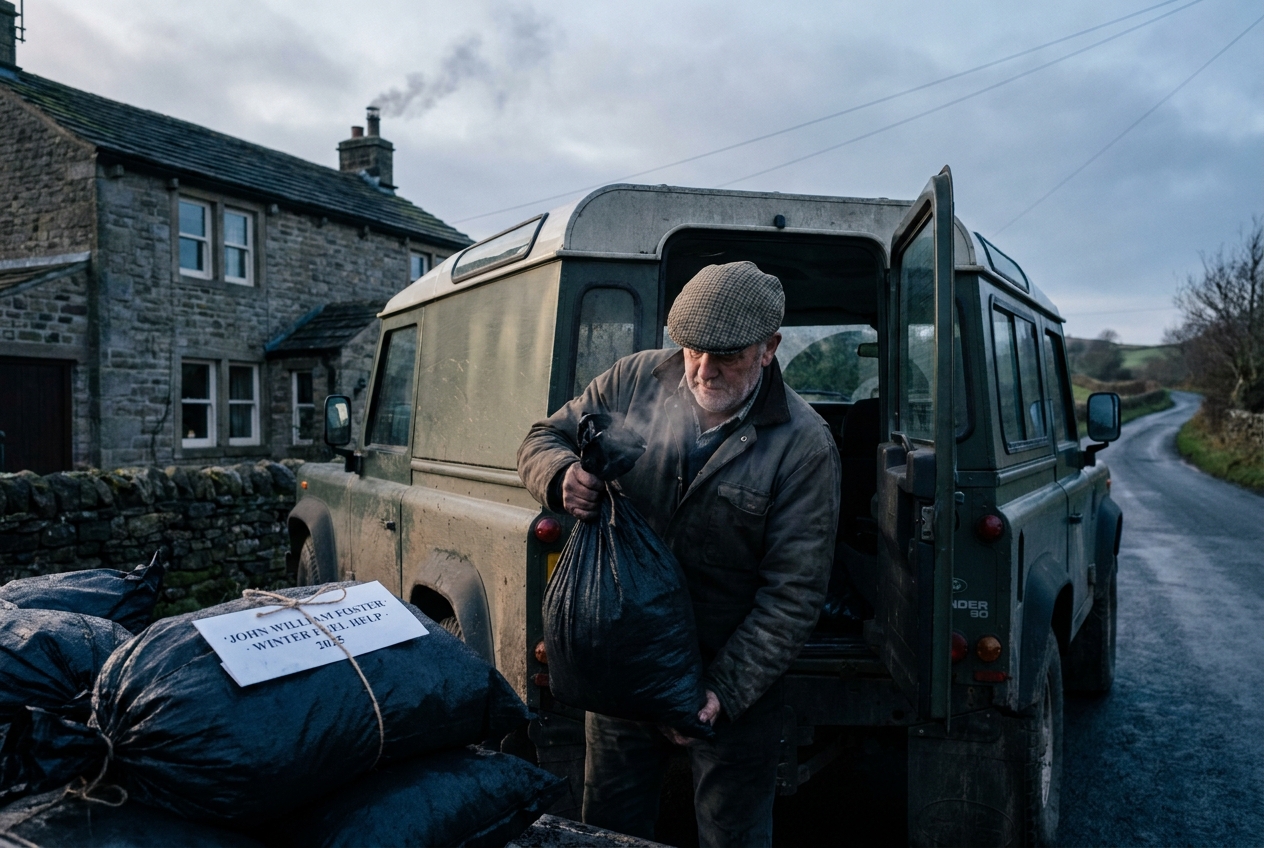
Four of the six payments this year were paid direct to the coal merchant in Settle, who runs an old-fashioned account for us. The merchant — Mr R. Iveson, who has known the dole since his father took it on in 1978 — delivers a small order to each named cottage and posts the receipt back to me with a single printed slip tied to the topmost bag. The slip is one of the small things we are proudest of: a cream-paper rectangle printed at the parish-hall printer in plain serif, reading JOHN WILLIAM FOSTER · Winter Fuel Help · February. It is, in some kitchens, the only piece of paper from the charity the recipient ever sees.
The other two payments were sent as cash, in a kraft envelope, with a printed slip of the same kind. One went to a household where the cooker is electric and the open fire is decorative, so a delivery of coal would have been more of a difficulty than a help; one went to a household where the recipient asked us not to send the merchant, on the perfectly reasonable grounds that she has already arranged the year's coal and would rather have a small contribution towards the next bill.
The numbers
For the record, here is what was spent. Households are not named.
- Household A · 2 bags smokeless solid fuel · £52.00
- Household B · 1 bag smokeless + 1 net of kindling · £38.40
- Household C · 2 bags smokeless solid fuel · £52.00
- Household D · 1 bag smokeless solid fuel · £26.00
- Household E · Cash envelope · £35.00
- Household F · Cash envelope · £33.10
- — Total — £236.50
The merchant's delivery charge is waived for our small orders and has been for as long as anyone can remember. We have asked him, more than once, to send a small invoice for the delivery time. He has politely declined. We acknowledge him by name in the annual report each year.
The slip on the bag of coal matters as much as the coal. Not because it is needed — but because it says, in plain serif, who has been thought of. — Trustees' minute, March 2025
The small change for next year
One small change, agreed at the March trustees' meeting. The cash envelopes have always been delivered by one of the trustees. From 2026, we will offer recipients the option of having the cash paid into a small account in their name, set up by them and held in their own name, with a single small printed slip posted to them on the same day, so that the paperwork is still on the dresser even though the money is in the bank. We will not make this the default — for some households the kraft envelope on a particular morning is the whole of the point — but we will offer it.
This is not the most radical change the dole has ever made. The trustees laughed about that when we agreed it. The most radical change we have ever made was probably the decision in 1978 to add the February distribution at all; everything since has been a small variation on the original Foster idea, which is to write a name on a piece of paper, put a small sum of money beside it, and walk both of them down a lane.
One enquiry, and how we answered it
We had one written enquiry this winter from outside the parish — a researcher at a university in West Yorkshire, working on small parochial charities and asking whether we would share anonymised case data. We said no, with apologies, and explained why: at our scale, anonymisation would not protect identities (six households in one parish is not a research sample), and the trustees feel strongly that the dole's covenant with the kitchen tables it reaches is more important than any external research, however well-intentioned. We pointed the researcher towards the Charity Commission's own public data and wished them luck.
We mention this enquiry not to flatter ourselves with our reply but to record that a small charity is sometimes asked to do things that, however reasonable they sound, would change what it is. The trustees have agreed a short paragraph in the minute book about this and will repeat it whenever asked.
And so
Six households. Four merchants' deliveries. Two kraft envelopes. £236.50 in total. One small change for next year. One enquiry, politely declined. The Winter Fuel Help round of 2025 is, in those few lines, the whole of what it was. I will be at the back of the village hall on the second Thursday of March, by which point the lambs will be in the upper fields and the next dispatch will be on the trustees' agenda. If you would like to write, the email address is [email protected].
— JD · Horton-in-Ribblesdale · 26 February 2025