I have been a trustee of this charity since the spring of 1999. I am, on the strict reading of our minute book, the longest-serving trustee at the present table; David Gallivan has been our Chair longer, but he came to the trustees some years after me. In the intervening twenty-six years I have, at various times, tried to find the original will of John William Foster — the man whose name we still bear, on whose bequest the parish dole has been distributed for a great deal longer than any of us can remember. I have not yet succeeded. This dispatch is a short account of what we do know, what we do not, and why the trustees have agreed, for the moment, to leave the gap in the record where it is.
The Charity Commission for England and Wales registered us on 27 November 1963 — not as a new charity, but as an existing one being recorded for the first time on what was then the modern register. Our entry under charity number 219863 carries the working name Horton-in-Ribblesdale Dole Charities, and the Commission's record reproduces a single short clause that summarises our purpose. The clause is the founder's own, lightly edited, and is reproduced in the register as 'financial aid monetary or otherwise to Widows and Spinsters over 60 years of age, Widowers over 80 years of age, and the poor of the Parish of Horton in Ribblesdale.' Anyone with a curiosity can find it on the public register at the Charity Commission's website.
What the parish papers tell us
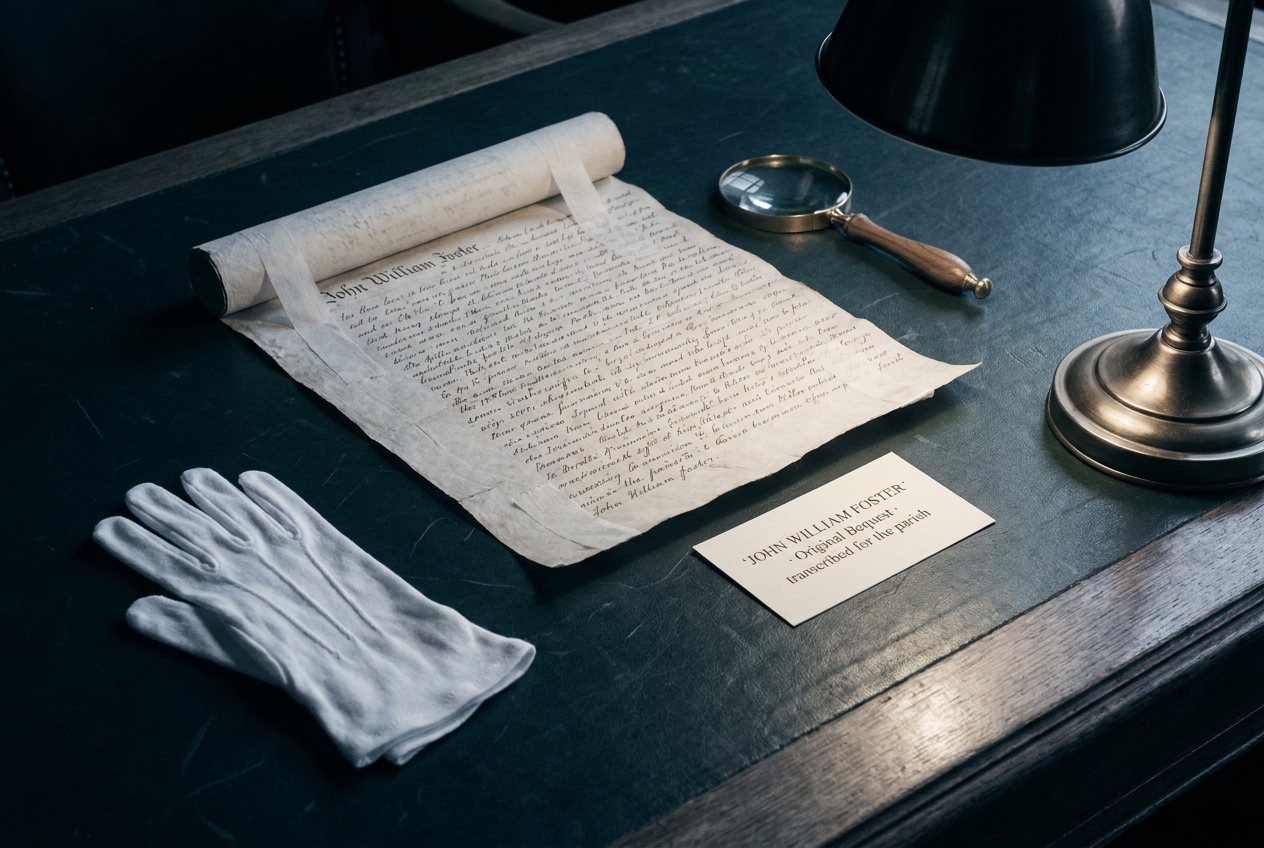
Our own archive is held in a single buckram folder at the back of the parish vestry, kept under a hand-written label that reads JOHN WILLIAM FOSTER · DOLE RECORDS. It contains, broadly, three kinds of paper: distribution sheets from successive Christmas doles, going back in fragmentary form to the early 1950s; trustees' minutes, complete from 1963 onwards and partial before then; and a single careful transcription, on cream paper, of an extract of the founder's will. The extract is undated; the transcriber's hand is the late Mr Edward Carr, churchwarden, who took on the task in 1971 and signed and dated his transcription 'St Oswald's, 14 February 1971'. He noted, in pencil at the foot, that the original will from which he had worked was at that point held by a firm of Settle solicitors and that he had been given two hours' access on a single afternoon.
The firm in question is no longer in Settle; the building they occupied on Duke Street is now a café. The successor firm, when contacted in 2002 by David Gallivan on his appointment as Chair, were unable to locate the file. We have not yet found a copy of the original will at the West Yorkshire Archive in Wakefield, nor at the Probate Search Service. The trustees agreed in 2018 that another careful look would be useful when a volunteer or trustee could spare the time. None of us has yet had it.
What the extract says
Carr's transcription runs to seven short clauses. They are written in the Victorian legal hand he was working from, and they preserve some of the period's quirks of capitalisation. The clause the Charity Commission later distilled is the second; the others set out the small endowment, name two original trustees (both long dead), and give a brief instruction on the manner of distribution. There is one line I find quietly moving: 'and the trustees aforesaid shall not so much advertise the Dole that it shame the recipients.' That is a tone we have, however unintentionally, kept ever since.
The trustees aforesaid shall not so much advertise the Dole that it shame the recipients. — John William Foster, will of (date unknown), as transcribed by E. Carr, 14 February 1971
What we still do not know
Three things, chiefly. We do not know the date of the original will. Carr's transcription does not record it, and the surviving distribution sheets are too sparse to triangulate against. We do not know who John William Foster himself was. The parish registers of St Oswald's record a small number of Fosters in the upper-dale farming families in the 1850s and 1860s, but no will-bearing John William Foster among them — which leads us to suspect he was a parishioner who had moved elsewhere by the time he wrote his will and asked, in it, to be remembered by the place. We do not know the precise circumstances of the original gift. There are family stories — most of them after-dinner stories, told at carol-service suppers — but we have written none of them down, on the principle that an after-dinner story written down becomes a history, and we would rather wait for the actual paper.
We have, with the agreement of the trustees, given the matter a small budget — £80 per year — for postage and photocopying connected with archival enquiries. We have not, in recent years, spent it. Volunteer Annette Henshaw, of Settle, has offered to look on our behalf at the Wakefield archive on her next visit. The trustees have written to thank her and will be glad of whatever she finds.
Why we are content to leave parts unfinished
I want to say something, in plain terms, about why the trustees are not in a hurry to fill the gap in the record. It is, partly, because we are a small charity and our time and energy are better spent on writing envelopes than on hunting wills. It is, partly, because what we know is enough: we know what to do, we know who to do it for, and we know in whose name. The Charity Commission has the legal text; the parish has the practice. The two together are sufficient.
It is also, partly, because there is a kind of charity that gets crowded out by its own founder. The big philanthropic foundations of the 20th century knew this. The kind of charity whose founder is on every plaque, in every brochure, in every appeal letter is a particular kind, and it is not ours. Mr Foster set down an instruction not to advertise the dole into shame for the recipients. We have, perhaps, extended that principle to ourselves: we do not advertise the dole into a story about its founder. He set it up; he is dead; the dole continues; the parish is kept warm a little longer than it would otherwise be. That is the whole of it.
If you have papers
I would be very glad to hear from anyone who has, in their own family papers, any letter, note, photograph, or document that mentions John William Foster, the dole, or the original parish trustees of the late nineteenth century. The trustees would be glad to receive copies (we do not need to keep originals). Please write to [email protected]. I will reply.
In the meantime, we will continue with the work. The next Christmas Dole is on the second Thursday of December. The next Winter Fuel Help is in the second weekend of February. The next dispatch is in January. We will, as always, write the envelopes by hand.
— DAM · Horton-in-Ribblesdale · 18 May 2025