
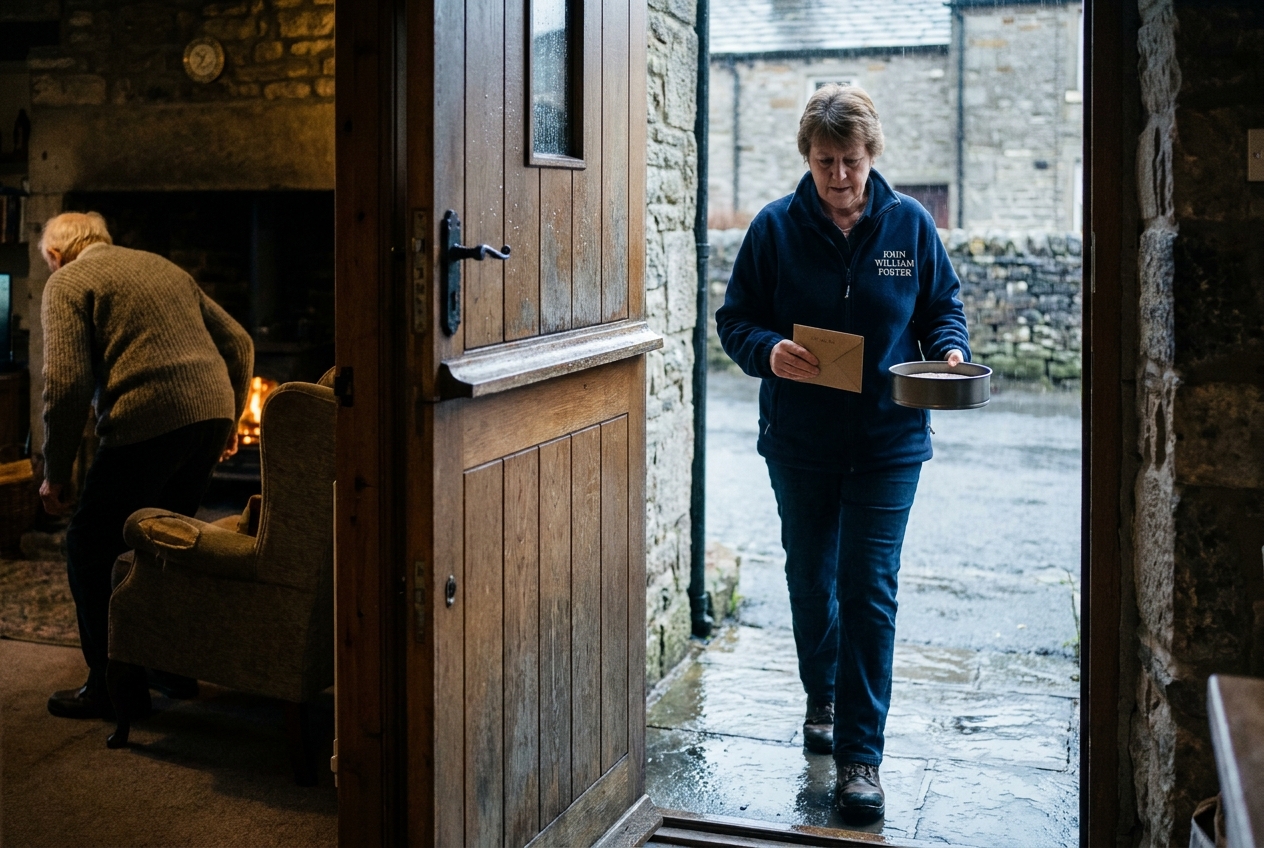
Margaret is 81 and she lives on the lane between the village and the upper farms, in the cottage her husband farmed out of for fifty-one years. He died in late September 2023. By the December that followed, the trustees of JOHN WILLIAM FOSTER had agreed her name and we walked an envelope to her door. She did not open it for some time. She told me, in the kitchen two months later, that she had thought it was a wrong address. The new postmistress had been delivering one or two strays. So she set it down on the dresser, beside the half-finished crossword in the parish magazine, and she did not look at it again until the New Year.
Then she turned it over. The back read, in plain serif type printed by the trustees on a strip of cream paper, JOHN WILLIAM FOSTER · Charity 219863 · with our quiet thanks. She knew the name. Her father had it on the mantelpiece of his cottage in Selside in 1962 — the same envelope, in roughly the same hand. She sat down at her kitchen table, opened it carefully, took out the small note inside, and read it twice. Then she was quiet, she said, for a while. She did not tell anyone for three weeks.
I record this with her permission. She read the piece you are reading now in late February and asked us only to change one word — to remove the phrase 'tearful' from where I had originally written it, on the grounds that it overstated. She is not, she said, a woman who is easily moved by paperwork. She is, she said, a woman who is easily moved by people doing what they said they would do.
What the envelope contained
Forty-five pounds, in three banknotes. The trustees had agreed it earlier that month at the quarterly meeting of 11 December 2025. We had also agreed an envelope of forty pounds for Arthur in Studfold, fifty pounds for Eileen in the village, and so on down a short handwritten list of fourteen names. The total was £590, which was a little above last year's. Income for 2025 had been steady. We had not had to take from the reserve.
None of those numbers are remarkable. They are the kind of numbers a small parish dole has always dealt in. We list them here because we are a tiny charity, and the only way for a tiny charity to be trusted is to put its small numbers on its own table, in the open, and say this is what we did, this is what it cost, this is what came back.
The rule we are relearning
Five years ago the trustees agreed, at my urging, that we ought to set up a more formal befriending scheme — a kind of monthly visit to each recipient by a paired volunteer. The minutes record that I was enthusiastic. The minutes also record that, by the fifth month, the rota had slipped. Two of our volunteers had taken on more visits than they could manage. One recipient had politely told us that she would prefer the envelope without the visit. The trustees stood the scheme down in 2023 and we have, in 2024 and 2025, returned to the older pattern: visiting where we are wanted, when we are wanted, without a rota.
Margaret's story has, I think, taught me something we already knew. The point of the envelope is not the visit. The point of the envelope is the envelope. The visit, where it happens, is a small good thing on top. To make the visit a precondition, or to schedule it as an obligation, would be to make the dole into a relationship rather than a gift. The original Foster bequest names a gift. The trustees should respect that.
The trustee who wrote the envelope had got the curl on the M just right. That is what mattered, in the end. — Margaret, 81, in conversation, February 2025
What we will do this year
Three small things. First, we will continue to write envelopes by hand. Second, we will continue to walk them to the door wherever the recipient and the trustee both want that; and to post them wherever they do not. Third, we will continue to visit — informally, with a kettle in mind, at the parish's natural pace.
We will not formalise the visiting rota again. We have learned that lesson. We will, however, write to all of last year's recipients in mid-October to check that the names on our list are still the right names, and to add — quietly, where we hear of them — any new neighbours the trustees ought to know about. If you live in the parish, and you know of someone we might have missed, you can write to [email protected] at any time of year.
And so
This is a short dispatch and I will not stretch it. Margaret is well. She has, in the year since her husband died, started visiting two of the other dole recipients herself — with cake, on a Wednesday afternoon, on a rota of her own making. The trustees did not ask her to. They did not arrange it. She is, in her quiet way, doing the thing we tried and failed to schedule.
That is, I think, exactly the right shape of it.
— DMG · Horton-in-Ribblesdale · 12 January 2026